
In 2026, the effectiveness of property management software for landlords is defined by its verification accuracy rather than simple task automation. You likely recognize that manual rent collection delays and disorganized maintenance tracking represent more than just administrative friction. These are operational vulnerabilities that directly compromise your rental ROI. Most professionals agree that the financial impact of an inaccurate tenant screening far outweighs the monthly subscription cost of a management platform. This guide provides a systematic approach to selecting and implementing a system that stabilizes your portfolio through precise screening and automated financial workflows.
We'll examine how to transition from reactive management to a centralized dashboard that ensures regulatory compliance and secures verified, high-quality tenants. Current data suggests that the right software can save you between five and ten hours per week by automating routine administrative tasks. We'll also address the specific features required to navigate 2026 regulatory standards, including regional rent caps and updated security deposit limits. By following this framework, you can replace manual uncertainty with a clinical, data-driven process that prioritizes portfolio security and long-term profitability.
Key Takeaways
- Modern property management software for landlords has transitioned from static spreadsheets to integrated digital ecosystems that automate the entire rental lifecycle.
- Effective platforms prioritize advanced tenant verification and secure digital payment gateways to eliminate manual rent collection delays and minimize eviction risks.
- Quantify the return on investment by calculating the specific hours recovered through automation and the financial protection provided by superior screening reports.
- Standardize your operational workflows using digital maintenance portals and automated lease renewal alerts to ensure high retention and portfolio stability.
- Implement a centralized dashboard to integrate financial performance tracking and maintenance management into a single, professional administrative system.
The Evolution of Property Management Software for Landlords
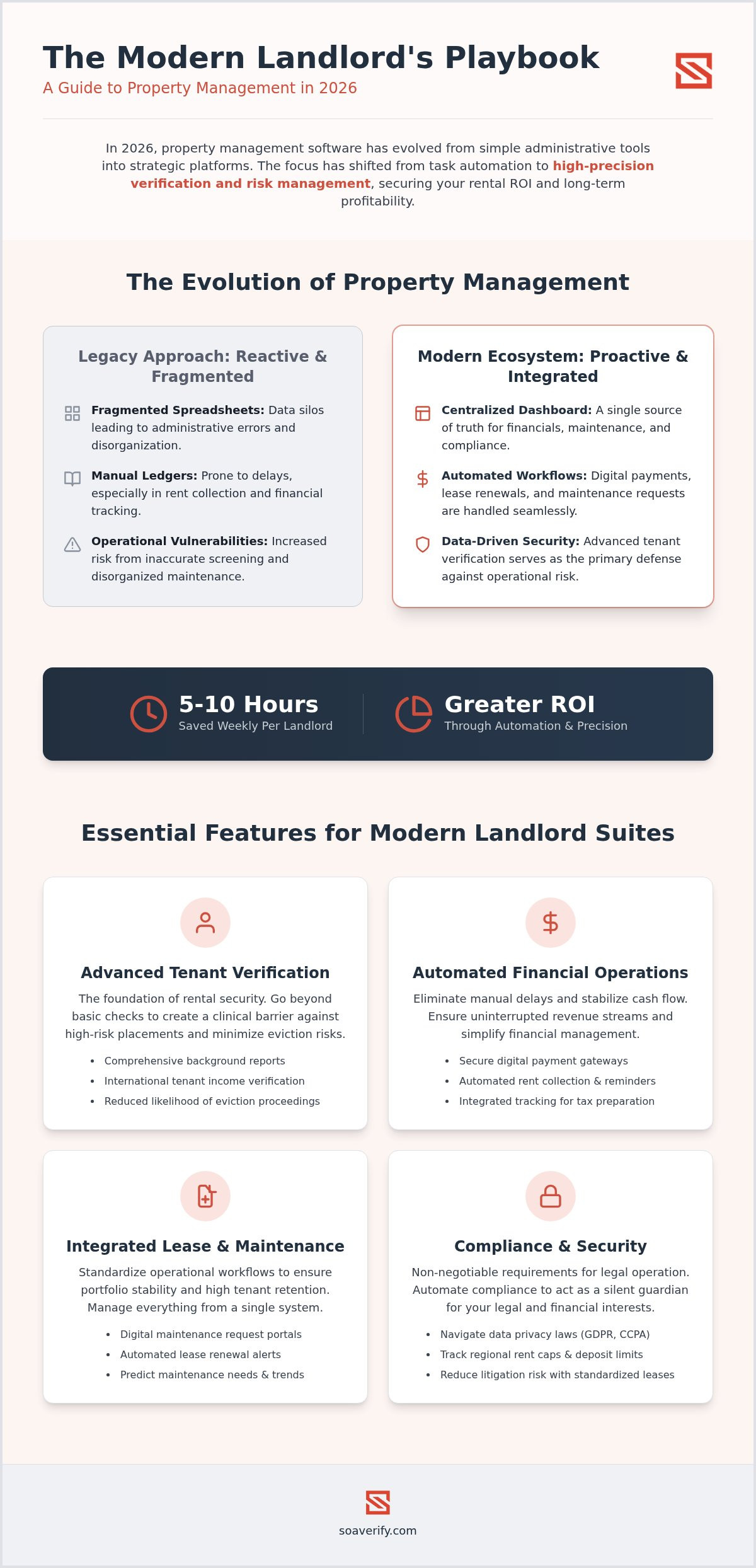
Professional property management software is a specialized SaaS category designed to automate the landlord-tenant relationship through digital workflows. Historically, landlords relied on fragmented spreadsheets and manual ledgers to track rental activities. This legacy approach frequently resulted in data silos and administrative errors. By 2026, the industry has transitioned toward cloud-based, integrated management ecosystems. These platforms consolidate rent collection, tenant screening, and maintenance tracking into a single source of truth. The modern requirement for property management software for landlords focuses on clinical precision rather than simple organization. Data-driven verification now serves as the primary defense against operational risk.
From Administrative Tools to Strategic Platforms
Modern software has moved beyond basic record-keeping to become a tool for proactive risk management. Earlier iterations of these platforms functioned as digital filing cabinets. Today, they operate as strategic partners that analyze real-time data to maintain high occupancy rates and optimize revenue. Cloud-accessible management portals allow you to oversee global portfolios from any location, removing the need for physical proximity to your assets. This transition is essential for landlords who manage properties across different time zones or jurisdictions. The shift toward strategic platforms means you can now predict maintenance needs and identify financial trends before they impact your bottom line. These systems provide the structural integrity required to scale a portfolio without increasing administrative overhead.
The Impact of Compliance and Security in 2026
Security and regulatory compliance are now the most critical components of any rental platform. Landlords must navigate evolving data privacy laws, such as GDPR and CCPA, which dictate how tenant information is stored and processed. Robust encryption and secure tenant verification are no longer optional features; they are non-negotiable requirements for legal operation. In 2026, property management software for landlords must also account for regional legislative changes. For example, software now includes specific modules to track compliance with California’s AB 1482 rent caps and updated security deposit limits. Standardized digital lease management ensures that every contract meets the specific legal criteria of its jurisdiction. This systematic approach reduces the risk of litigation and ensures that your data handling practices remain transparent and secure. By automating these compliance checks, the software acts as a silent guardian for your legal and financial interests.
Essential Features for Modern Landlord Software Suites
Selecting the right property management software for landlords requires a transition from viewing these tools as digital ledgers to viewing them as operational engines. In 2026, the baseline for performance involves high-precision automation and real-time data synthesis. These features don't just organize data; they actively mitigate the risks associated with manual administrative processes. A modern suite must function as a silent partner that executes complex tasks with clinical accuracy.
Tenant Verification and Background Reports
Modern screening must account for a globalized workforce. Verifying international tenant income is now a critical requirement for maintaining portfolio stability across different jurisdictions. Integrated background checks provide a level of validation that reduces the statistical likelihood of future legal eviction proceedings. A Comprehensive Screening Report serves as the foundation of rental security by providing a definitive audit of an applicant's financial and behavioral history. Landlords who utilize these Tenant Screening Reports establish a clinical barrier against high-risk placements while ensuring regulatory compliance.
Automated Financial Operations
Automated rent collection eliminates the delays inherent in manual check processing. Secure digital payment gateways provide immediate confirmation of funds, which stabilizes monthly cash flow. These systems also manage rent renewals and automated payment reminders, ensuring that revenue streams remain uninterrupted. Integrated rent tracking simplifies tax preparation by categorizing all income and expenses in real-time. This level of transparency reduces friction in the landlord-tenant relationship, as both parties have access to a verified ledger of financial transactions. By removing the human element from collection, you ensure that financial cycles remain predictable and objective.
Beyond financial transactions, effective property management software for landlords must centralize asset maintenance. A dedicated maintenance management portal allows tenants to submit service requests directly, ensuring that property issues are logged and addressed with surgical clarity. This proactive approach protects the long-term value of the asset and prevents small repairs from escalating into significant liabilities. Finally, financial performance dashboards offer real-time visibility into the health of your entire portfolio. These dashboards aggregate data to show net operating income and yield, allowing for informed decisions regarding portfolio expansion or optimization based on actual performance data rather than estimates.
Evaluating the ROI of Digital Management Platforms
Measuring the return on investment for property management software for landlords requires an analysis of both direct cost savings and indirect risk mitigation. It's a mistake to view software as a mere expense; it's a tool for capital preservation. Professional platforms justify their cost by replacing manual labor with automated, clinical processes. When you eliminate the need for physical rent collection and manual data entry, you secure your most valuable resource: time.
According to research from unithub.ai published in January 2025, property management software can save landlords between five and ten hours per week by automating routine tasks. This recovery of time allows for the strategic oversight of a portfolio rather than getting stuck in administrative minutiae. Beyond time, the financial impact of avoiding a single high-risk tenant through superior screening is significant. The costs associated with evictions and property damage often far exceed the annual subscription for a management platform. Systematic verification acts as a financial insurance policy for your assets.
Scalability is another critical factor in the ROI equation. Managing more than five units effectively without professional property management software for landlords is nearly impossible for a solo landlord. As a portfolio grows, the complexity of tracking multiple leases and maintenance requests increases exponentially. A centralized system provides the structural integrity needed to scale without adding significant overhead.
Quantifying Administrative Efficiency
Digital lease management significantly reduces the "days to lease" metric. By accelerating the application and signing process, you minimize vacancy periods and maximize monthly revenue. When you perform a cost-benefit analysis of subscription fees versus the cost of your own manual labor, the software's value becomes clear. Centralized data also improves decision-making speed. You can access a financial performance dashboard to evaluate your current cash flow and determine the feasibility of new property acquisitions with surgical clarity.
Long-Term Asset Value Protection
There's a documented correlation between organized maintenance tracking and property appraisal values. A maintenance management portal ensures that minor issues are addressed before they become expensive structural repairs. This proactive approach preserves the physical integrity of the asset. Professional communication channels also reduce tenant turnover. Tenants who experience reliable, app-based interactions are more likely to renew their leases. You can use integrated financial reporting to identify underperforming assets in your portfolio, allowing you to reallocate capital to more profitable ventures.
Implementing Maintenance and Lease Management Workflows
Operational precision in 2026 depends on the transition from reactive tasks to standardized digital workflows. When you implement a systematic maintenance and lease management process, you remove the ambiguity that often leads to tenant friction and property depreciation. Utilizing a dedicated property management software for landlords allows you to establish a clinical audit trail for every asset in your portfolio. This structure ensures that no request is overlooked and every lease renewal is executed with administrative accuracy. By automating these repetitive cycles, you maintain a steady operational rhythm that supports long-term portfolio stability.
A centralized system also facilitates the integration of third-party service providers directly into your management ecosystem. This connectivity ensures that contractors receive work orders instantly, reducing the time between a reported issue and its resolution. To optimize your administrative efficiency, you should leverage the digital lease management and maintenance portal features available in professional platforms. These tools provide the transparency required to manage complex workflows without increasing your personal workload.
Streamlining the Maintenance Lifecycle
The digital maintenance workflow begins the moment a tenant submits a request through the portal. This request automatically generates a work order, which you can then assign to a verified contractor with a single click. Every step of this process, from initial report to final invoice, is logged within the system. This comprehensive maintenance history is essential for insurance claims and liability protection, as it proves a consistent standard of care. Clear, automated communication between all parties ensures that tenants are informed of repair schedules while landlords maintain oversight of contractor performance and costs.
Digital Lease Agreements and Renewals
Modern lease management has moved toward a 100% paperless model. Using electronic signatures and secure document storage ensures that all agreements are legally compliant with 2026 regional standards. Automated renewal alerts notify both you and the tenant well in advance of a lease expiration, which prevents administrative bottlenecks and maintains high occupancy rates. Your software should maintain a secure digital archive of all historical lease documents, providing immediate access to data for audits or property sales. This systematic approach to documentation reduces the risk of lost records and ensures that your legal standing is always protected by a verified data trail.
Scaling Your Portfolio with SOAVerify
Scaling a real estate portfolio requires a platform that functions with clinical precision. SOAVerify serves as the preferred property management software for landlords who prioritize security and data accuracy over aesthetic features. By integrating tenant screening, automated rent collection, and maintenance management into a single professional dashboard, the platform removes the operational friction that often hinders growth. This unified approach ensures that every data point, from a background check to a maintenance invoice, is validated and accessible. It acts as a silent partner, maintaining the structural integrity of your business as it expands.
The platform's global coverage is a distinct advantage for landlords with international property interests. SOAVerify provides cross-border verification capabilities; this allows you to screen tenants and manage properties across different jurisdictions with the same level of scrutiny. This clinical approach to verification builds long-term trust between landlords and tenants by ensuring that all interactions are based on verified data and transparent processes. It functions as a guardian of your data, maintaining the integrity of your operations while you focus on strategic acquisition and capital allocation.
The SOAVerify Advantage: Beyond Basic Automation
SOAVerify leverages advanced background checks to secure higher-quality rental agreements. Unlike basic screening tools, these reports provide a comprehensive audit of an applicant's history, which significantly reduces the statistical likelihood of future defaults. The Financial Performance Dashboard then uses this data to drive strategic growth. By providing real-time visibility into net operating income and yield, the dashboard allows you to identify which assets are performing at peak efficiency. This level of insight is essential for professional administrators who value logic and data-driven decision-making. The platform's foundation in real estate expertise ensures that every feature serves a specific, technical purpose in your management lifecycle.
Getting Started: Your Professional Management Transition
Transitioning to a new system is a methodical process. You can migrate your existing tenant data into the SOAVerify ecosystem using standardized import protocols that ensure data integrity. Once your portfolio is uploaded, configuring your first automated rent collection cycle is the next logical step. The system handles payment reminders and funds verification automatically, establishing a predictable revenue stream from day one. This transition moves your operations from manual uncertainty to a state of controlled, professional management. Implementing this property management software for landlords ensures that your portfolio is prepared for the complexities of the 2026 rental market.
Optimize your rental operations with SOAVerify's comprehensive management suite today.
Securing Your Portfolio’s Future
Transitioning to a digital management ecosystem is no longer a matter of convenience; it's a requirement for operational security. You've seen how clinical precision in tenant screening and automated financial workflows protect your revenue streams. By centralizing your data, you reduce administrative friction and ensure long-term compliance with 2026 standards. These systems replace manual uncertainty with a steady, predictable rhythm of portfolio oversight.
The implementation of property management software for landlords allows you to move from reactive tasks to a proactive, data-driven strategy. This shift maximizes your rental ROI and provides the structural integrity needed to scale your portfolio without increasing overhead. Professional administrators recognize that the value of their time is best spent on strategic growth rather than routine data entry.
SOAVerify provides the tools necessary to maintain this level of control. You can access Advanced Tenant Verification, Automated Rent Collection, and a Comprehensive Maintenance Portal through a single, professional interface. Start your professional property management journey with SOAVerify today to stabilize your assets and secure your financial performance. Your transition to a more efficient, verified management process starts here.
Frequently Asked Questions
What is the best property management software for small landlords?
The best property management software for landlords with small portfolios often includes platforms like Innago or UnitHub, which offer robust entry-level tiers for limited property counts. These options provide essential functionality such as digital record-keeping without the high monthly minimums required by enterprise-grade systems. For landlords prioritizing security and operational precision, SOAVerify offers a more specialized approach to verification and lifecycle management. The choice depends on whether your priority is basic organization or a strategic management ecosystem.
How does property management software handle tenant screening reports?
Software handles tenant screening by automating the request and delivery of comprehensive background data. When an applicant submits their details, the system generates Tenant Screening Reports that include credit history, criminal records, and eviction data. This process ensures that you receive verified information directly from the source, removing the risk of applicant-altered documents. These reports serve as a clinical audit trail for your placement decisions and provide the foundation for rental security.
Can I collect rent online safely using landlord software?
You can collect rent online safely through secure digital payment gateways integrated into the software. These platforms utilize ACH processing or credit card transactions with standard encryption to protect financial data. Typical ACH fees range from $1 to $2 per transaction, providing a cost-effective alternative to manual checks. Automated systems eliminate the delays associated with physical mail and provide immediate digital receipts for both parties, which stabilizes your monthly cash flow.
Is it worth paying for property management software for just one rental?
Paying for software is often worth the investment even for a single rental due to the significant risk mitigation it provides. Automation can save a landlord between five and ten hours per week by handling administrative tasks and financial tracking. More importantly, the cost of a bad tenant or a legal error in a lease agreement far exceeds the subscription fee. Using professional software ensures that your single asset is managed with the same precision as a large portfolio.
How do maintenance portals improve tenant retention?
Maintenance portals improve retention by providing tenants with a transparent and responsive communication channel. When a tenant submits a request, the system logs the entry and provides real-time updates on the status of the repair. This transparency reduces tenant frustration and ensures that small maintenance issues don't escalate into major structural problems. A well-managed maintenance lifecycle demonstrates a high standard of care, which encourages tenants to renew their leases and stay longer.
Does property management software assist with lease renewals and digital signatures?
Most modern platforms facilitate paperless lease management through integrated electronic signatures and automated renewal alerts. These systems notify you and your tenants well before a lease expires, preventing administrative bottlenecks and vacancy periods. Digital signatures are legally compliant with 2026 standards in most jurisdictions, ensuring that your agreements are enforceable and securely archived. This systematic approach to renewals maintains high retention rates and provides a clear digital history of all contractual changes.
What security features should I look for in property management software in 2026?
In 2026, security features must include robust data encryption and full compliance with privacy regulations like GDPR or CCPA. You should look for software that offers secure tenant verification and multi-factor authentication to protect sensitive personal and financial data. Systems must also provide standardized digital lease signatures that meet the specific legal requirements of your local jurisdiction. These features act as a silent guardian, ensuring that your data handling remains transparent and legally sound.
How do financial dashboards help landlords track property performance?
Financial dashboards help you track performance by aggregating real-time data into a single, professional view of your portfolio. These dashboards display critical metrics such as net operating income, cash flow, and asset yield. Having immediate access to this information allows you to identify underperforming properties and make informed decisions about capital allocation. By moving away from manual spreadsheets, you gain surgical clarity into the financial health of your rental business and can plan for strategic growth.