

A single bad placement can negate an entire year of rental yield through delinquency and legal costs. While many property owners rely on intuition, objective data remains the only reliable shield against administrative disorder. Learning exactly how to run a background check on a tenant is no longer optional for those seeking to protect their physical and financial assets. It's a technical requirement for modern property management that prioritizes stability over guesswork.
You likely recognize that manual document collection is often slow and prone to sophisticated forgery. This guide provides a systematic, repeatable verification framework designed to reduce vacancy rates and secure objective proof of a tenant's financial reliability. We'll examine the precise process of vetting applicants, including digital income validation, identity verification, and navigating local regulations. By the end of this article, you'll have the tools to transform your screening process into a high-precision administrative system.
Key Takeaways
- Define the core components of a systematic screening framework, covering financial, criminal, and rental history.
- Implement a methodical workflow for how to run a background check on a tenant that begins with a standardized digital application.
- Utilize automated income verification to secure objective financial data and bypass the vulnerabilities of manual document reviews.
- Integrate verification reports into a centralized digital management system to ensure consistent property performance and reduced turnover.
Essential Components of a Systematic Tenant Screening Framework
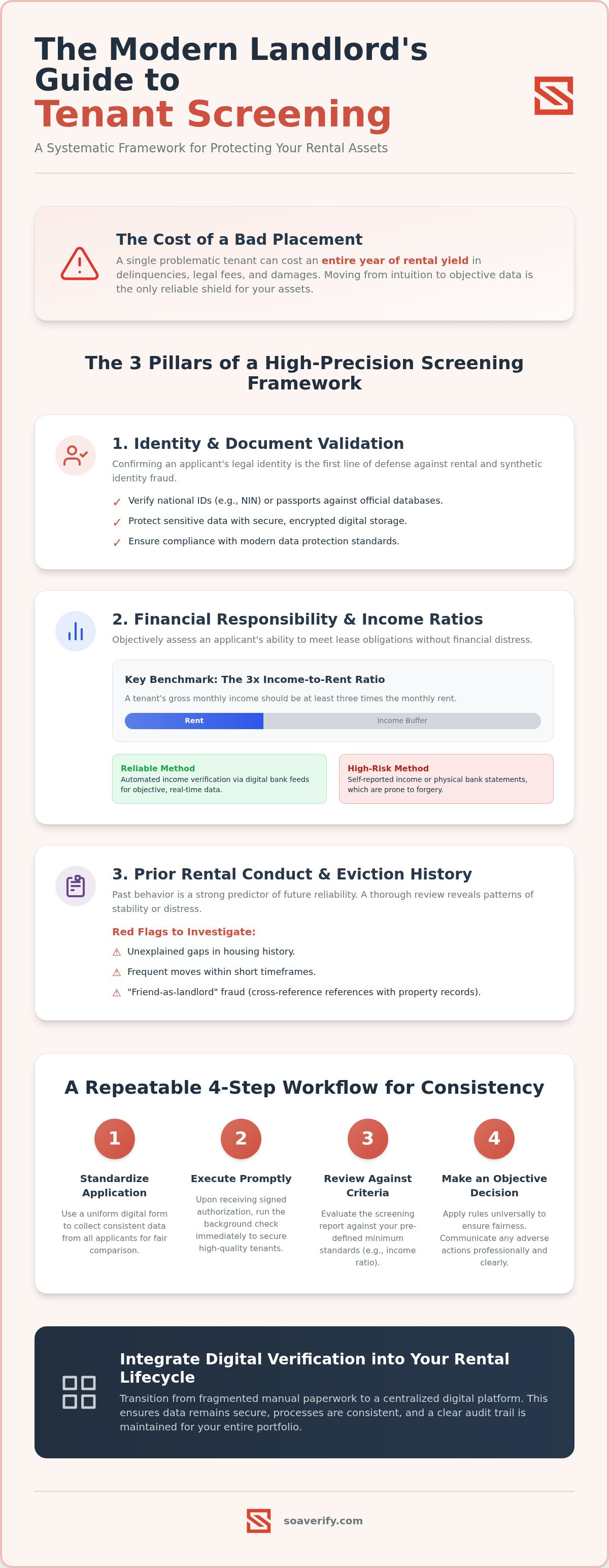
A landlord background check is a structured evaluation of a prospect’s financial history, criminal record, and previous rental conduct. Relying on intuition often leads to administrative friction or significant financial loss. Objective data provides the only verifiable baseline for risk mitigation. When you understand how to run a background check on a tenant, you move from a reactive posture to a controlled, professional standard. This process requires more than a basic credit pull. While a credit score indicates past debt management, a comprehensive tenant screening report offers a holistic view of the applicant's reliability across multiple jurisdictions.
A high-precision framework focuses on three primary data points:
- Identity Verification: Confirms the legal existence and history of the applicant.
- Income Stability: Validates the consistent flow of funds required to meet lease obligations.
- Prior Rental Conduct: Documents past behavior, including evictions or property damage.
Identity and Document Validation
Verification begins with confirming the applicant is who they claim to be. In Nigeria, this involves validating the National Identification Number (NIN) or an international passport against official databases. Identity validation serves as the primary barrier against rental fraud and synthetic identity theft. Landlords must handle this sensitive personal data with clinical precision. It's vital to store digital records in secure, encrypted environments to ensure compliance with 2026 data protection standards. Knowing how to run a background check on a tenant involves more than just looking at an ID; it requires a commitment to data security and accurate document handling.
Financial Responsibility and Income Ratios
Financial vetting ensures the applicant can sustain the lease terms without distress. A standard industry benchmark is the 3x income-to-rent ratio. This calculation requires that the tenant’s gross monthly income equals at least three times the monthly rent. Relying on self-reported gross income is risky. Instead, prioritize verifiable liquid assets and digital bank feeds. These methods provide a more accurate reflection of financial health than easily forged physical bank statements.
A Methodical Workflow for Executing Tenant Background Checks
Operational consistency requires a repeatable sequence of actions. You must establish a standardized application form to collect uniform data points from every prospect. This parity allows for an objective comparison of candidates. Once you receive the signed authorization, execute the tenant background check immediately. Prompt execution prevents the loss of high-quality prospects to other listings. Understanding how to run a background check on a tenant effectively involves more than just reading a report; it requires a disciplined administrative routine.
Synthesizing these findings requires a final review against your pre-set criteria. This ensures your decision-making process remains data-driven and defensible. Automating these steps through digital lease management reduces the risk of human error and maintains a clear audit trail for every property in your portfolio.
Screening for Rental History and Evictions
Reviewing previous residency patterns reveals much about an applicant's stability. Identify red flags such as unexplained gaps in housing history or frequent moves within short periods. These patterns often correlate with undisclosed evictions or financial distress. Always verify the authenticity of landlord references. Cross-reference contact information with property ownership records to detect "friend-as-landlord" fraud. This step ensures that the feedback you receive is genuine and professional.
Objective Decision Making and Adverse Action
Define your minimum criteria for every property before reviewing applications. These benchmarks might include a specific credit threshold or the income-to-rent ratios established in the previous section. Applying these rules universally ensures non-discriminatory practices. If an applicant fails to meet these standards, communicate the denial professionally. A clear, clinical explanation of the administrative decision reduces friction and maintains the integrity of your screening process.
Integrating Digital Verification into the Rental Lifecycle
Modern property management requires a transition from fragmented manual paperwork to a centralized tenant screening platform. This shift ensures that data remains secure and accessible throughout the entire rental lifecycle. Learning how to run a background check on a tenant is most effective when the results integrate directly into your operational workflow. SOAVerify facilitates this by linking background reports with automated rent collection and lease renewal systems. This integration creates a continuous record of tenant performance, moving beyond a simple point-in-time check.
Maintaining compliance with 2026 data privacy standards is essential for landlords handling sensitive documents like NIN records in Nigeria. Encrypted digital portals replace unsecured email chains, providing a verifiable audit trail. This systematic approach reduces administrative friction and protects both the property owner and the applicant from data breaches. It's a necessary step for any professional who values technical precision and data integrity.
Digital Income Verification vs. Manual Bank Statements
Direct-to-source income verification significantly reduces the risk of forged or altered financial documents. Manual bank statements are increasingly susceptible to sophisticated digital manipulation. Automated verification systems connect directly to financial institutions to confirm liquidity and income consistency in real-time. These systems populate financial performance dashboards, allowing landlords to track long-term reliability without the need for repetitive manual reviews. You don't have to worry about the authenticity of the data when it comes directly from the source.
The Future of Verification: Global Databases
The rental market is increasingly mobile, requiring verification processes that span international borders. Cross-border verification aids in vetting expatriates or international tenants entering the Nigerian market by accessing global databases. This evolution marks a shift toward continuous screening. Instead of a single check at the start of a lease, property managers can now monitor risks throughout the lease lifecycle. This ensures that the tenant's status remains consistent with the original approval criteria, providing long-term security for the property portfolio.
Establishing a Resilient Property Management Framework
A professional screening standard protects your property from the administrative and financial risks of rental delinquency. A systematic approach ensures that every applicant is evaluated against the same objective criteria, from identity validation to income-to-rent ratios. By mastering how to run a background check on a tenant through digital tools, you eliminate the vulnerabilities of manual document reviews and fragmented workflows. This technical precision creates a stable foundation for consistent rental performance.
Adopting a centralized platform allows you to maintain order throughout the entire lease lifecycle. You'll gain access to automated NIN and identity verification alongside integrated financial performance dashboards and secure digital lease management. These tools provide the transparency needed to make informed decisions with confidence. Secure your rental assets with SOAVerify’s professional screening tools. Implementing these systems today ensures your portfolio remains resilient and profitable for years to come.
Frequently Asked Questions
How long does a typical landlord background check take in 2026?
Digital verification systems typically return results within 24 to 48 hours. Understanding how to run a background check on a tenant using digital tools often shortens this window by bypassing manual data entry. While automated identity checks are nearly instantaneous, manual outreach to previous landlords or employers can extend the timeline. Efficient property managers use centralized platforms to minimize these delays and reduce vacancy periods.
Can a landlord perform a background check without the tenant’s consent?
Landlords cannot legally perform a background check without the applicant's explicit written authorization. Obtaining consent is a mandatory step in the process of how to run a background check on a tenant. This requirement ensures compliance with data privacy regulations and protects the property owner from legal liability. Always include a clear authorization clause in your standardized application form to maintain administrative order.
What is the most important factor to look for in a tenant screening report?
The most critical factor is the combination of income stability and previous rental conduct. A high-precision screening report provides objective data on whether the applicant can consistently meet the established income-to-rent ratios. Verifying past eviction records and payment history offers a predictive baseline for future performance. These metrics provide a more reliable risk assessment than a simple credit score or personal intuition.
What documents should a landlord request for a professional background check?
A professional verification process requires government-issued identification, such as a National Identification Number (NIN) or passport. You should also request digital proof of income, including bank feeds or employment letters, to validate financial reliability. Collecting contact details for previous landlords and professional references allows for the execution of a structured questionnaire. These documents form the data foundation required for a thorough and defensible screening framework.


