

A signed lease agreement is not a guarantee of future revenue. It is a legal obligation that remains only as secure as the applicant's verified history. You likely recognize that manual tenant screening is often inefficient and leaves room for significant operational risk. Relying on intuition rather than data can lead to property damage or the financial friction of non-payment. These variables create unnecessary complexity in an environment that requires administrative order.
This guide provides the framework to master the verification process as a systematic discipline. By adopting a clinical approach to applicant data, you'll learn to secure reliable tenants and protect the long term value of your property investment. Our objective is to replace uncertainty with a repeatable, data-driven process that minimizes vacancy rates and maximizes asset security.
We'll examine a comprehensive screening checklist designed for modern landlords. This includes specific methods for validating complex or international income streams and the protocols required to maintain strict legal compliance. By the end of this article, you'll have the tools to transform your verification workflow into a streamlined, professional standard.
Key Takeaways
- Define tenant screening as a systematic evaluation of suitability to mitigate long-term property risk.
- Identify objective indicators of financial stability and responsible behavior to ensure consistent rent collection.
- Implement a structured verification framework that prioritizes identity confirmation and financial capacity analysis.
- Optimize administrative workflows by integrating comprehensive screening reports directly into digital lease management systems.
- Reduce vacancy rates and operational friction through automated application intake and clinical data verification.
Understanding Tenant Screening: The Foundation of Property Management
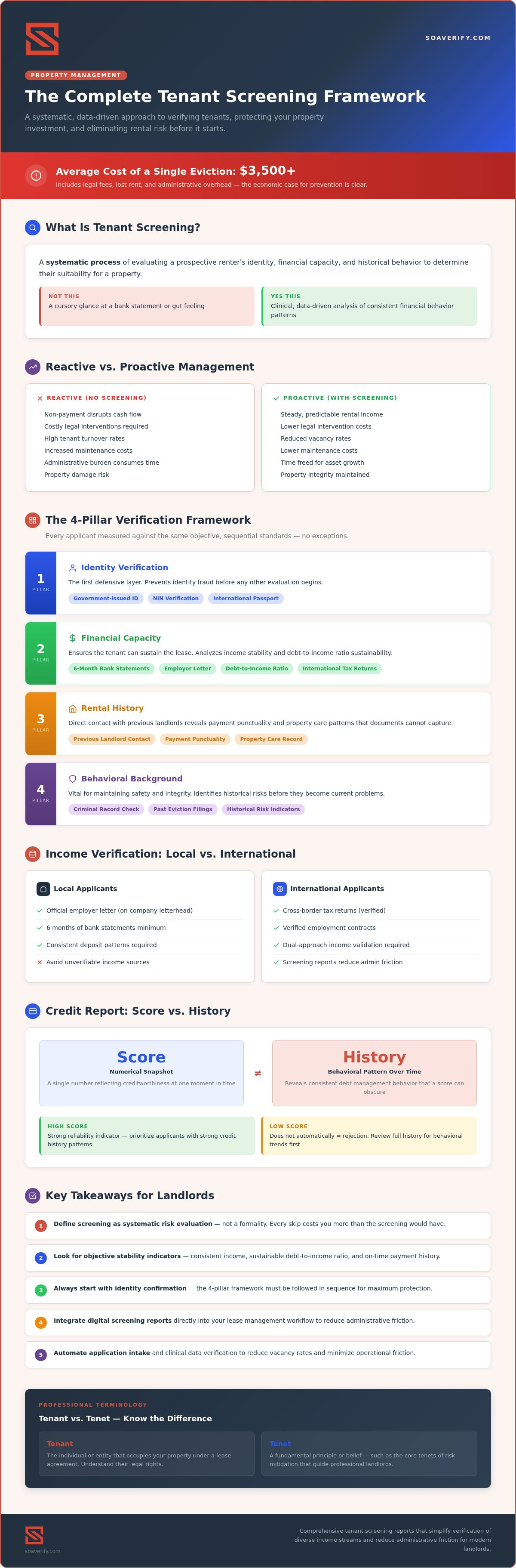
Effective tenant screening is the systematic process of evaluating a prospective renter's history to determine their suitability for a property. It's a clinical verification of identity, financial capacity, and historical behavior. Rather than a cursory glance at a bank statement, a rigorous screening protocol involves a thorough analysis of data points that indicate future performance. This process serves as the primary filter for protecting your capital investment and maintaining operational order.
The core objective is to identify reliable indicators of stability. You aren't just looking for a name; you're looking for a consistent pattern of financial responsibility. This includes verifying that an applicant's income is stable and their debt-to-income ratio is sustainable. By quantifying these risks early, you establish a baseline for property security. It's the most effective tool available for preventing future evictions and property damage before they occur.
A common linguistic error in property management is the confusion between "tenant" and "tenet." A tenant is the individual or entity that occupies your property under a lease agreement. A tenet is a fundamental principle or belief. Successful landlords must master both. You must understand the legal rights of the tenant while adhering to the core tenets of risk mitigation. Clarity in terminology reflects a professional standard that builds trust with all stakeholders.
The Consequences of Inadequate Screening
Failure to implement a rigorous screening process introduces volatility into your portfolio. High-risk tenants often lead to non-payment, which disrupts cash flow and necessitates costly legal interventions. Beyond the direct financial loss, the administrative burden of managing difficult occupants consumes time that should be spent on asset growth. This friction often results in higher turnover rates and increased maintenance costs.
Industry data indicates that the average cost of an eviction, including legal fees and lost rent, often exceeds $3,500 per instance. This figure underscores the economic necessity of prevention. A proactive approach ensures that your property remains a source of steady income rather than a liability requiring constant oversight. By prioritizing tenant screening, you transition from reactive management to strategic asset protection.
The 4-Pillar Framework for Comprehensive Tenant Verification
A robust tenant screening process relies on a four-pillar framework designed to eliminate ambiguity. By following a structured sequence, you ensure that every applicant is measured against the same objective standards. This methodology transitions the selection process from subjective intuition to clinical data analysis.
- Identity Verification: Confirming the applicant's identity is the first defensive layer. You must validate government-issued IDs, such as a National Identification Number (NIN) or an international passport, to prevent identity fraud.
- Financial Capacity: Analyzing income stability ensures the tenant can sustain the lease. A sustainable debt-to-income ratio is a primary indicator of long-term payment reliability.
- Rental History: Contacting previous landlords verifies past behavior. Direct communication often reveals payment punctuality and property care patterns that documents cannot capture.
- Behavioral Background: Reviewing criminal records and past eviction filings identifies historical risks. This step is vital for maintaining the safety and integrity of your property.
Verifying International and Local Income
In the Nigerian rental market, verifying income requires a dual approach. For local applicants, official employer letters and six months of bank statements provide necessary transparency. Look for consistent deposit patterns and avoid documents with unverifiable sources. When dealing with international tenants, request cross-border tax returns or verified employment contracts. Utilizing tenant screening reports simplifies the validation of these diverse data sets and reduces administrative friction.
The Role of Credit Reports in 2026
Credit reports remain a critical component of the verification process. It's essential to distinguish between a credit score and credit history. A score is a numerical snapshot, while history reveals a person's behavior over time. While a low score doesn't always necessitate a rejection, a high score serves as a strong indicator of reliability. Meticulous review of credit history allows you to identify trends in debt management that a single number might obscure.
Optimizing the Screening Workflow with SOAVerify
Efficiency in property management requires the integration of disparate tasks into a single, cohesive workflow. By using SOAVerify, you can embed Tenant Screening Reports directly into your Digital Lease Management process. This alignment ensures that no applicant proceeds to the contract stage without meeting your established risk thresholds. Automated application intake removes the variability of manual data entry, providing a consistent dataset for every prospect you evaluate.
Once an applicant passes the screening phase, the system facilitates a seamless transition to electronic lease signing. This continuity reduces the time between approval and occupancy, which directly impacts your bottom line. Following the execution of the lease, the platform initiates Automated Rent Collection. This ensures that the financial stability identified during the tenant screening phase translates into consistent, predictable cash flow. It's a logical progression that replaces administrative guesswork with technical precision.
To monitor the long term success of your selection process, the Financial Performance Dashboard provides real-time data on your portfolio's health. It tracks payment trends and occupancy metrics, allowing you to refine your screening criteria based on actual tenant behavior. This data-driven feedback loop ensures your risk mitigation strategy remains effective as market conditions evolve. You aren't just filling units; you're building a portfolio of verified, high-performing assets.
Standardizing the Leasing Lifecycle
Consolidating verification and management onto a single platform minimizes administrative friction. It eliminates the need for redundant data entry across multiple tools and reduces the risk of clerical errors. Managing sensitive applicant information within a secure environment is paramount for professional landlords. SOAVerify prioritizes data security and privacy compliance, ensuring that all personally identifiable information is handled according to strict industry standards. This creates a secure environment for both you and your applicants.
To begin improving your operational standards, you can initiate your first screening report through the SOAVerify dashboard. This simple action marks the transition from manual, high-risk processes to a professional, automated system. By standardizing your leasing lifecycle today, you ensure the long-term stability of your property investment.
Establishing a Standard for Property Security
Transitioning from manual verification to a systematic framework is the most effective way to secure your property investment. By adopting the 4-pillar framework, you replace subjective intuition with clinical data analysis. This shift ensures that every applicant is measured against objective standards of identity and financial capacity. Standardizing these protocols eliminates the administrative friction that often leads to high turnover and non-payment.
Implementing a rigorous tenant screening protocol is a strategic necessity for any professional portfolio. Utilizing a platform that integrates Professional Tenant Screening Reports with Secure Digital Lease Management and Automated Rent Collection Systems creates a logical, efficient lifecycle for your properties. This level of technical precision allows you to maintain high-quality occupancy while minimizing operational risk.
Start screening your next tenant with SOAVerify today to establish a new standard of order and stability for your investments. We're ready to help you build a more reliable and profitable property management workflow.
Frequently Asked Questions
What is included in a standard tenant screening report?
A standard report includes identity verification, credit history, criminal background checks, and eviction records. It provides a comprehensive overview of an applicant's financial reliability and behavioral history to help landlords make data-driven decisions. These reports aggregate data from multiple sources to ensure the information is both current and accurate.
How long does the tenant background check process usually take?
The duration typically ranges from 24 to 72 hours depending on the depth of the verification required. While automated digital reports provide immediate results for identity and credit, manual verification of employment or previous landlord references can extend the timeline. Using an integrated platform often accelerates this process by centralizing data collection.
Can I screen international tenants who do not have a local credit history?
Yes, you can screen international tenants by requesting alternative documentation such as international passports, cross-border tax returns, and verified employment contracts. Professional tenant screening services often provide specific data points for international markets to bridge the gap in local credit data. This ensures you maintain a consistent risk mitigation standard regardless of the applicant's origin.
Is it legal to charge an application fee for tenant screening in Nigeria?
Nigerian law does not explicitly prohibit application fees, but landlords must ensure fees are reasonable and transparent. It's standard practice to use these fees to cover the actual costs of conducting background checks and administrative processing. Landlords should clearly communicate the purpose of the fee and provide a receipt to maintain professional transparency.
What are the most common red flags to look for during a tenant interview?
Significant red flags include inconsistencies in employment history, reluctance to provide government ID, and a history of frequent moves. Landlords should also be wary of applicants who pressure for immediate move-in without completing the full verification process. These behaviors often indicate a desire to bypass the objective tenant screening standards you have established.
How does tenant screening help with automated rent collection later on?
Screening identifies tenants with a proven history of punctuality and sufficient income stability. By selecting applicants who meet these financial thresholds, you increase the success rate of automated rent collection systems and reduce the likelihood of payment failures. This proactive selection process ensures that your automated financial workflows function without the friction of manual intervention.


