

The era of managing a real estate portfolio from a static desktop workstation has ended. In 2026, a property management app must function as a secure verification engine rather than a simple task manager. You likely find your current workflow fractured across disparate email threads, manual SMS logs, and the constant anxiety of tenant income fraud. These administrative frictions don't just waste time; they introduce significant financial risk into your operations. Delayed rent payments and maintenance backlogs are often the direct result of using outdated, manual systems that lack integrated logic.
This article provides a clinical evaluation of the leading mobile solutions to help you establish a single source of truth for your property data. We examine how modern platforms automate rent collection and provide instant, verified tenant screening reports to eliminate manual backlogs. By comparing the technical capabilities and pricing structures of the industry's primary tools, we identify the optimal mobile command center for landlords who prioritize systematic precision. You'll learn how to transition from reactive administration to a proactive, automated management style that values accuracy and data integrity above all else.
Key Takeaways
- Understand the transition from office-bound software to a portable administrative ecosystem that enables field-ready operations.
- Evaluate a property management app based on its ability to automate rent collection and provide instant, verified tenant screening reports.
- Audit technical architectures for data security, prioritizing platforms that maintain AES-256 encryption and SOC 2 compliance standards.
- Distinguish between the limited functionality of DIY tools and the robust verification logic found in professional-grade platforms.
- Establish a single source of truth for property data to eliminate fragmented communication and maintenance request backlogs.
The Evolution of Property Management: Transitioning to a Mobile-First App
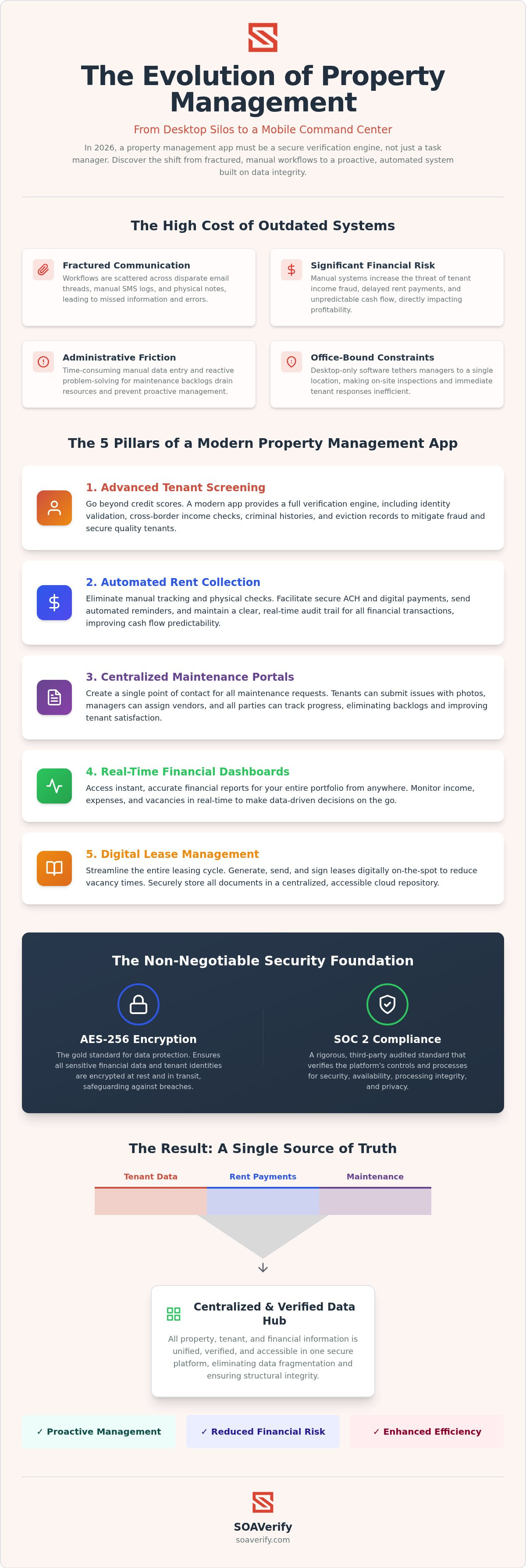
The definition of property management software has undergone a fundamental shift. It's no longer a database restricted to a desktop terminal. Instead, a modern property management app functions as a portable administrative ecosystem. This transition moves operations from office-bound constraints to field-ready efficiency. Landlords in 2026 require this mobility to maintain oversight during on-site inspections and tenant turnovers. Precision in data entry at the point of contact reduces the risk of administrative errors that typically occur when notes are transcribed hours later. Professional-grade mobile security serves as the baseline for these tools. Every reliable platform must utilize AES-256 encryption and maintain SOC 2 compliance to protect sensitive financial data and tenant identities.
Desktop Software vs. Native Mobile Apps
Responsive websites often fail to meet the rigorous demands of active property managers. They rely on persistent internet connectivity and lack the deep integration required for hardware-level features. Native mobile apps provide distinct advantages. Push notifications ensure that urgent maintenance requests or rent alerts reach the manager instantly. This immediacy is critical for maintaining high tenant satisfaction scores. Additionally, professional apps offer offline capabilities. This allows managers to document property conditions or update records in basements or remote areas with poor cellular reception. The data syncs automatically once a stable connection is restored.
The Role of Real-Time Data in Modern Leasing
Real-time data access directly impacts the vacancy-to-lease cycle. When a manager can access tenant screening reports on-site, they can verify a prospect's eligibility within minutes. This speed prevents high-quality leads from pursuing other properties. Mobile rent tracking also improves cash flow predictability. Managers can identify late payments the moment they occur and initiate automated reminders without returning to an office. Digital lease signing on-the-spot further reduces friction. It captures signatures during the showing, securing the tenant before they leave the premises. Using a dedicated property management app ensures that every interaction is logged in a single source of truth, maintaining the structural integrity of the property record.
Essential Features of a Professional Property Management App in 2026
A professional property management app serves as the primary interface for complex real estate logic. In 2026, the baseline for software has shifted from simple record-keeping to active automation. Landlords now require systems that handle the critical intersections of identity, finance, and maintenance without constant manual oversight. A professional-grade solution must integrate five core components: advanced tenant screening, automated rent collection, centralized maintenance portals, real-time financial dashboards, and digital lease management. These features create a systematic record that serves as the single source of truth for your entire portfolio.
Verification and Screening: The Security Pillar
Tenant quality remains the most significant variable in portfolio performance. Basic credit scores no longer provide sufficient protection against sophisticated identity and income fraud. A modern app must facilitate thorough tenant screening that includes full identity verification and cross-border income validation. This is especially critical in urban centers where international applicants are common. Comprehensive reports should aggregate criminal histories, eviction records, and verified employment data into a single, legible document. Integrating these results directly into your lease generation workflow ensures that only verified individuals proceed to the signing stage. For those seeking maximum precision, SOAVerify's verification engine provides the clinical accuracy required to mitigate high-level risks.
Financial Automation and Rent Collection
Eliminating physical checks and manual data entry is essential for maintaining a clear audit trail. Automated rent collection facilitates secure ACH and digital payments through a centralized interface. The system should apply late fees automatically and send payment reminders based on the specific terms of the digital lease. This reduces delinquency rates by removing the friction of manual follow-ups. Real-time ledger updates ensure that your financial records are always current. For a more technical analysis of these processes, you can review our guide on property management software for landlords. This level of financial automation creates a predictable cash flow and allows for accurate portfolio performance visualization through integrated dashboards.
Maintenance Portals and Digital Lease Management
Centralizing maintenance requests prevents the data fragmentation that occurs within SMS and email. A professional property management app allows tenants to submit requests with photo and video attachments. This visual data helps landlords triage issues and assign vendors with surgical clarity. Digital lease management further streamlines the process by providing state-specific templates with integrated e-signatures. These templates must be updated to reflect 2026 regulatory changes, such as the new stove and refrigerator requirements in California. By consolidating these functions into one mobile environment, you reduce the administrative friction that leads to maintenance backlogs and legal non-compliance.
Comparing App Architectures: DIY Landlord Tools vs. Enterprise Platforms
Selecting a property management app requires an evaluation of its underlying architecture. Most mobile solutions fall into three distinct categories: DIY tools, mid-market platforms, and enterprise systems. Each tier offers different trade-offs between cost and functional depth. While entry-level apps focus on basic task management, enterprise solutions prioritize portfolio-wide data integrity and complex financial logic. Professional landlords must decide between an "all-in-one" ecosystem and a "best-of-breed" approach. Best-of-breed systems often utilize API integrations to connect with dedicated accounting and tax compliance software. This architectural choice determines how effectively your software handles the transition from reactive tasks to systematic management.
The DIY Trap: When Free Apps Cost You More
Free or low-cost apps often present a "DIY trap" for growing landlords. These tools frequently rely on manual data entry. This increases the probability of administrative errors that lead to financial discrepancies. Free platforms also tend to utilize non-standardized screening reports. Using unverified data in high-stakes rentals introduces significant legal and financial risks. Professional risk mitigation requires lawyer-reviewed templates for every lease and addendum. A premium property management app ensures these documents remain compliant with evolving state regulations. The initial savings of a free tool rarely offset the cost of a single legal dispute or a fraudulent tenant.
Scalability: From 1 Unit to 100
App performance must remain consistent as your portfolio grows. Many consumer-grade apps degrade as data complexity increases. This results in slower load times and fragmented records. Transitioning from a single unit to a 100-unit portfolio requires multi-user access with permission-based roles. This ensures that team members only access relevant data, which maintains internal security. Scaling also requires a shift from simple rent tracking to comprehensive financial performance dashboards. These dashboards provide real-time ROI visualization and automated tax preparation. A scalable app acts as a silent partner. It manages the background logic so you can focus on strategic portfolio growth.
Selection Audit: How to Evaluate a Property Management App for Your Portfolio
Landlords must move past surface-level feature lists to conduct a clinical audit of their chosen property management app. This evaluation ensures the software meets technical benchmarks for security and operational efficiency. You shouldn't rely on marketing claims; instead, verify that the vendor employs AES-256 encryption for all data at rest and in transit. Test the latency of the tenant screening and verification process. A professional system should return verified results within a predictable timeframe to prevent vacancy loss. Assess the maintenance portal by simulating a vendor assignment. The communication flow must be logical, allowing for photo uploads and status updates that both parties can view in real-time.
The Tenant Experience Audit
A friction-heavy interface for tenants directly correlates with higher turnover and delayed payments. If a tenant finds it difficult to submit a maintenance request or set up automated rent payments on mobile, they're less likely to engage with the system. Evaluate the app's user experience (UX) by performing a trial rent payment from a tenant perspective. The process should be intuitive and require minimal steps to complete. It's also vital to ensure the platform maintains a transparent, time-stamped communication log. This log provides an objective record of interactions that can resolve disputes before they escalate. High-quality UX isn't a luxury; it's a tool for maintaining cash flow stability.
Security and Compliance Checklist
Compliance with the Fair Housing Act (FHA) is a technical requirement, not just a policy. The app must handle sensitive Personally Identifiable Information (PII) using secure protocols that prevent unauthorized access. This includes the encrypted storage of social security numbers, income documents, and government IDs. SOC 2 compliance serves as a rigorous audit standard that verifies a service organization's systems are designed to protect tenant and landlord data through specific security, availability, and privacy controls. Ensuring these standards are met reduces the risk of data breaches that could lead to significant legal liability. Don't settle for platforms that haven't undergone external security audits.
Audit your current workflow and explore the SOAVerify platform to implement these clinical standards today.
SOAVerify: The Clinical Choice for Secure Property Management
SOAVerify operates as an authoritative specialist at the intersection of verification and automation. It's designed for landlords who require a high-level administrator rather than a generic task manager. The platform functions as a meticulous silent partner. It manages complex financial logic and identity validation in the background. This allows you to focus on strategic portfolio growth while the system maintains the structural integrity of your data. By integrating advanced tenant screening directly with automated rent collection, the platform eliminates the fragmentation typical of entry-level software. It's a precise property management app built for the rigorous demands of the 2026 rental market.
Advanced Verification as a Competitive Advantage
High-stakes rental markets demand more than basic credit checks. SOAVerify’s background check services utilize advanced logic to identify and filter out "professional tenants" who exploit system loopholes. This clinical precision reduces the likelihood of costly evictions and protects your cash flow. High occupancy rates are further supported by automated lease renewals. The system identifies upcoming expirations and initiates the renewal process without manual intervention. For landlords looking to expand, the financial performance dashboard provides real-time data visualization. These insights allow for data-driven acquisitions based on verified performance metrics rather than speculative estimates. You gain a clear understanding of your portfolio's health through literal and specific data points.
Implementing SOAVerify in Your Daily Workflow
Transitioning to a new property management app shouldn't disrupt your existing operations. Onboarding a new property onto the SOAVerify platform follows a logical, step-by-step progression. You begin by defining the property parameters and inviting existing tenants to the portal. The system facilitates the migration of historical data with minimal administrative friction. Once established, the maintenance management portal creates operational order by centralizing all service requests. Tenants submit issues through a structured interface, ensuring that no detail is lost in a fractured SMS or email thread. This systematic approach ensures that every maintenance task is logged and tracked to completion.
Landlords seeking a more professional approach to management can begin the transition immediately. The next step involves a comprehensive audit of your current tenant data to ensure accuracy before migration. By adopting this clinical-grade solution, you establish a secure, automated foundation for your real estate business. The objective is clear. You move away from reactive administration toward a state of controlled, data-backed oversight. This transition ensures your portfolio remains resilient, compliant, and profitable in an increasingly complex regulatory environment.
Establishing a Systematic Foundation for 2026 Portfolio Growth
The transition to a mobile-first environment is more than a convenience; it's a shift toward operational precision. Selecting the right property management app requires a clinical evaluation of security protocols and background logic. As we've established, the most effective systems move beyond simple task management to provide a single source of truth for your entire portfolio. You'll reduce administrative friction by prioritizing platforms that offer advanced tenant verification and background checks alongside an integrated maintenance management portal. These tools ensure that your data remains secure and your cash flow remains predictable through automated financial performance dashboards.
Adopting a specialized solution allows you to operate with the authority of a specialist. It's time to replace fragmented communication and manual entries with a structured, automated ecosystem. You can explore the SOAVerify property management platform today to begin this transition. Establishing these systematic controls now ensures your business remains resilient in an increasingly complex regulatory landscape. You're now equipped to manage your properties with unwavering attention to detail and surgical clarity.
Frequently Asked Questions
What is the best property management app for landlords with small portfolios?
Landlords with small portfolios should seek a property management app that offers enterprise-grade security without enforcing high unit minimums. Some platforms are optimized for portfolios under 50 units, providing the same verification logic used by larger firms. The focus should remain on the quality of the data rather than the volume of units managed.
Are property management apps secure for handling tenant social security numbers?
Security is a technical requirement for any platform handling personally identifiable information. Professional apps use AES-256 encryption and follow SOC 2 compliance standards to protect social security numbers and income documents. This architecture ensures that sensitive tenant data is inaccessible to unauthorized parties.
Can I collect rent through a property management app without transaction fees?
Rent collection via ACH is often the most cost-effective method for both parties. While credit card transactions typically incur a percentage-based processing fee, many platforms include automated ACH transfers within their standard subscription tiers. This eliminates the need for manual check processing and physical bank deposits.
Do property management apps include tenant screening and background checks?
Comprehensive screening is a core pillar of modern management software. A professional property management app provides integrated reports that include credit history, criminal background checks, and eviction records. These reports help landlords identify potential risks before a lease is executed.
How much does a professional property management app cost in 2026?
Costs in 2026 are generally structured as either a flat monthly fee or a per-unit charge. Professional platforms often require a minimum monthly investment to maintain the integrity of their verification engines and security certifications. Scaling your plan as your portfolio grows ensures that you only pay for the capacity you actually utilize.
Can tenants submit maintenance requests through the app?
Maintenance portals allow tenants to submit requests with visual documentation directly through their mobile interface. This creates a time-stamped record of the issue and facilitates direct communication with vendors. Centralizing these requests prevents the data loss common in SMS or email-based workflows.
Does a property management app help with tax preparation and 1099s?
Automated financial dashboards simplify tax preparation by maintaining a continuous ledger of income and expenses. The system can categorize costs and generate the necessary data for 1099-MISC or 1099-NEC forms. This reduces the administrative burden during tax season and ensures compliance with federal reporting requirements.
Is it possible to sign a lease agreement digitally within the app?
Digital lease management allows for the execution of legally binding agreements within the app environment. These templates are updated to reflect current state-specific regulations and utilize integrated e-signatures for rapid processing. This speed is essential for maintaining high occupancy rates in competitive markets.


